Powered by Let’s Do Something

Industry Report | May 2026

Israel Defense-Tech 2026 Q1-Q2

From Battlefield Urgency to Industrial Scale

A field-level look at Israel’s defense-tech ecosystem as it moves from emergency innovation to real industrial capacity — where founders, investors, primes, and partners are trying to turn prototypes into funded, validated, deployable systems.

01

Executive Summary

An ecosystem at a defining inflection point.

P. 02
02

Market Reality

Size, structure, procurement, and capital flows.

P. 03–04
03

Structural Gaps

Where the ecosystem breaks down in 2026.

P. 05
04

The Sandbox Model

Early-stage infrastructure for founders and investors.

P. 06–08
05

Industry Voices

Founders, primes, educators, and investors.

P. 09–27
06

Mandate

Build, integrate, deliver.

P. 28–30

Executive Summary

An Ecosystem at a Defining Inflection Point

Israel's defense-technology ecosystem stands at a defining inflection point. Since October 7, defense innovation has shifted from a specialized sector to a central pillar of national resilience. Talent mobilized rapidly. Capital reoriented. Government procurement accelerated. Founders with direct battlefield experience began building companies at unprecedented speed.

The question now is no longer whether Israel can innovate under pressure. It is whether Israel can convert urgency into durable industrial capability.

This report examines:

  • The size and structure of Israel's defense-tech ecosystem
  • Capital and procurement flows
  • Early-stage bottlenecks
  • The strategic role of pre-seed and early growth capital
  • The Core Challenge
  • The transition from battlefield validation to institutional delivery
  • The path toward global scale, particularly in the United States

Israel has always excelled at improvisation. The challenge ahead is industrialization: transforming battlefield credibility into repeatable product development, scalable manufacturing, procurement fluency, and global export capacity.

As operators working closely with early-stage defense founders, government stakeholders, and capital partners across the ecosystem, we see firsthand where momentum converts into deployment and where it stalls. Our vantage point sits at the intersection of pre-seed architecture, operational validation, and procurement reality. This report is not a theoretical analysis of the sector. It is a synthesis shaped by direct engagement with the founders building, the institutions buying, and the investors underwriting the next generation of Israeli defense capability.

Market Reality (MAFAT + SNC 2025 Info)

Size, Structure & The Signals That Mattered at the end of 2025

Industry Footprint (2025)

312

Registered Companies | Aerospace, defense, and homeland security (SNC 2025 map)

221

Direct Companies worked directly with MAFAT

137

War Effort Startups still contributing to the war effort

Defense-tech is no longer peripheral. It is structured, measurable, and institutionally engaged. Approximately 63.7% of companies are located in central Israel, signaling clustering effects but also potential geographic concentration risk.

Noise vs. Signal

Israel's defense-tech ecosystem is more active than at any point in its history. Panels debate future battlefields. Investment theses circulate widely. Working groups multiply. Ministers and political parties are rallying for a Defense Sovereignty Strategy. Every stakeholder has a view on what Israel must build next. Activity alone, however, is not velocity. In defense markets, opinions do not move procurement. Slide decks do not deploy. Theory does not survive operational testing. The only signals that matter are tangible:

  • Demonstrations
  • Paid pilots
  • Contracts
  • Deployments
  • Revenue

Israel is now transitioning from wartime improvisation to structural industrial build-out. The ecosystem's durability will depend on conversion rates, not conference attendance.

Procurement Flows & Sector Allocation (MAFAT + SNC 2025 Info)

Procurement & Capital

Government Orders

NIS 1.22B

Startup orders in 2024

NIS 1.08B

Startup orders in 2025 — ~25% from foreign customers

NIS 1.5B+

Total startup orders since the Swords of Iron war began (As of Q1 2026)

NIS 297M

Foreign orders received by just 17 startups in 2025 alone


MAFAT has become a catalytic anchor. Companies that received a direct MAFAT order in 2025 raised $1.2B in total funding. For pre-seed and seed companies, MAFAT orders represented 34% of funding volume, compared to 17% in Series A and 15% in Series B+. This government validation functions as leverage capital.

Sector Allocation of Government Orders (2025)

Autonomy and AI dominated procurement demand. Next-gen autonomous platforms (UGV, CCA, UAS/C-UAS, AUVs) that will operate as collaborative teammates with natural language interfaces and world models—requiring minimal human input are the frontier for future deployments. This has continued to be a centerpiece of the defense market in 2026.

Autonomous Platforms · 32.5%
AI / Digital Systems · 19.9%
Cyber · 17.7%
Sensors / Detectors · 9.3%
Other · 20.6%

Source

Structural Gaps

Where the Ecosystem Breaks Down in 2026

Gap 01

The Earliest Capital Gap

Defense hardware requires capital before traction. Founders often seek microchecks under $50K to reach the technological proof of concept stage and validate the product user fit before incorporating. These are frequently missing. MAFATand IIA funding has been the main source thus far but research and POC funding is expected to be limited in 2026 and onwards. Founders are expected to be resourceful and fundraise elsewhere initially and while requesting funds from the government.

Gap 02

Procurement Strategy Gap

The Valley of Death persists between pilot and contract. Founders must navigate documentation rigor, certification requirements, and budget alignment in order to obtain their pilot. On top of this all, the time between application, first contract and first government funding still makes it hard for motivated founders to jump in and deploy products in a timely fashion. Founders are expected to find a ‘dual use’ market to financially fill the gap that the defense contracts create. Often, companies end up leaving the defense market altogether once their dual use case pans out and finds early user fit.

Gap 03

Trust-Market Fit

Defense is not only product-market fit. It is a trust-market fit. Companies that scale behave early like institutional counterparties: compliance architecture, documentation and standards discipline, reference customer strategy, reputation building. Trust compounds faster than revenue in defense markets. Young companies that deliver product but can’t behave like the primes when it comes to everything else are left without a follow on contract post pilot. Founders must be prepared and organized accordingly.

Gap 04

Industrialization and Internationalization Gap

Improvisation is Israel's strength. Repeatable production, integration, and export discipline remain the next frontier. It still remains to be seen if we can turn on and scale our startup manufacturing ability, in Israel and amongst our allies around the globe and if we can deploy these new technologies to foreign allies. Israel is meant to be the launchpad for these companies. Many must still land a foreign customer in order to grow.

Industry Voice | The Sandbox

A Letter to the Founders Building

Building Defense Companies That Actually Ship

Israel’s defense-tech ecosystem has more energy than I have ever seen. Founders, investors, government partners, soldiers, engineers, and industry leaders are all showing up with urgency and seriousness. That matters.

The challenge is not that people are missing. The challenge is that the earliest infrastructure layer is still hard to reach for many good ideas.

There are brilliant young founders building demos, testing concepts, and identifying real operational problems. But many of them are still too early for traditional investors, too inexperienced for defense procurement, and too under-resourced to reach the next milestone on their own.

That is the gap The Sandbox is built to fill.

We focus on the ground floor: the stage where a founder has a demo, a serious problem, and a clear next target — but needs a small check, trusted feedback, customer access, and practical guidance to keep moving.

Sometimes that means a five-figure POC check from our angel investors club. Sometimes it means an introduction to an international or local partner. Sometimes it means helping a young founder understand how to build a company, navigate regulation, structure a team, speak to customers, or prepare for their first real funding conversation.

Industry Voice | The Sandbox

The on-ramp still needs work.

The adults are in the room. The investors are here. The government is here. The defense industry is engaged. But the on-ramp still needs work.

If we do not help convert young technical talent into capable founders, a lot of good ideas will be left behind. A lot of real problems will continue to exist. And Israel will miss out on companies that could have been built.

This is not a new pattern. Many of the world’s most important technology companies started with young founders who did not yet know how to build a company. They had technical talent, intensity, and a product direction — but they needed someone to believe early, help them mature, and give them the first shot.

That is what we need to do for Israeli defense tech.

Israel already has major success stories. Companies like XTEND, HEVEN, Tenna and InTACT show what is possible when operational insight, technical talent, customer access, and capital come together. We can do more of that. We can build the on-ramp that turns raw talent and urgent ideas into real companies serving Israel and its allies.

At The Sandbox, that is the mission.

Early-stage founders don’t fail because they can’t build. They fail because they can’t close the gap between: a working idea → a funded, deployed product.

That gap is where most companies die.

And it usually comes down to three things:

  • Investors willing to move early
  • Customers willing to engage before everything is perfect
  • Teammates who can actually execute

Not advisors. Not spectators. Operators.

The Sandbox Model

Capital, validation, and executable next steps.

At The Sandbox, this is what we focus on.

We work with founders who are:

  • Ready to or recently incorporated
  • Building toward a real product
  • And need their first capital and first validation

$20K

POC check

$50K–$150K

First round check

Pilot

Early pilot access with real users

We’ve built an international angel investor group across the U.S., Canada, and Europe that is aligned around this stage.

They don’t wait for polished companies. They invest when something is real — but early.

Our pipeline starts earlier.

Through BUILD — Building in University for Israel’s Defense, we work with students to:

  • Form teams
  • Solve real IDF and MAFAT challenges
  • Build working prototypes
  • Incorporate new companies and deploy to the field for testing

Inside The Sandbox, the goal is simple:

We help startups get to an executable next step toward funding. That can be:

  • An investor introduction
  • A pilot opportunity
  • A customer conversation

The takeaway

If it doesn’t move them forward, it doesn’t matter.

If you’re building for national security, you don’t need more opinions.

You need:

  • Capital to get started
  • Customers to validate
  • People who can execute

That’s what we do.

For founders:

If you’re ready to build and raise your first capital, apply for an introduction to our angel investors.

Pitch Your Company

For investors:

If you want access to early-stage defense companies before they’re visible to the market, email Ike Bodner to set up a discovery meeting.

Email Ike

IAI ELTA (Prime)

Should Fast, Innovative Startups Work with a Defense Corporation?

And No, It’s Not Just About Patriotism.

IAI ELTA logo

IAI | ELTA Division |
Strategy and Technologies

Nitai Kaniel - Open Innovation Lead

* This article reflects the author’s views only.

This article explores the changes reshaping the defense market, and why, despite the inherent frictions, startups should work with defense corporations.

It’s easy to start with the obvious: the value of working with a company like ours. In recent years, that value has become something that goes without saying. But it’s far from the only reason to work with a defense corporation.

If you were to ask many entrepreneurs what comes to mind when they look at defense corporations, you’d likely hear: rigid conservatism, long cycles, bureaucratic bottlenecks, and a pace that feels disconnected from the startup clock. There is truth in that, but it’s only half the picture. The other half is the step-change a successful partnership can create: a faster path to market, often much harder to achieve alone.

Each year, I review roughly a thousand startups and meet a few hundred in one-on-one conversations. In less than two years, we’ve run a few dozen proofs of concept (POCs) with startups, working closely with our business and technology teams, several have already matured into commercial agreements, while others are progressing in that direction. But the numbers themselves are not the story. They reflect something deeper: the beginning of a structured internal shift in how we partner with startups.

IAI ELTA (Prime)

Redefining the Defense Market

Anthropic: Annualized Revenue Trajectory (2023-2026)

$0.1B$1.0B$9.0B$30.0BDec 2023Jan 2025Dec 2025Apr 2026

Figure. Source: Anthropic public disclosures (run-rate revenue) in company announcements. Source

The shift in the defense market is tectonic. This isn’t just a new label, it's structural transformation. We are witnessing the biggest disruption this market has experienced in decades.

Some examples:

  • Technological: beyond the technology leap itself, the entire lifecycle is being reshaped: from early development, through delivery of sensors and edge software, and into robotics and autonomous systems.
  • New entrants: we are seeing new players from the civilian market, including companies that not long ago kept their distance and were highly reluctant to engage in this field, Google being a prominent example. Anthropic is another signal of the steep AI curve: it says Claude is deployed in classified national security environments and has a DOW/CDAO contract.
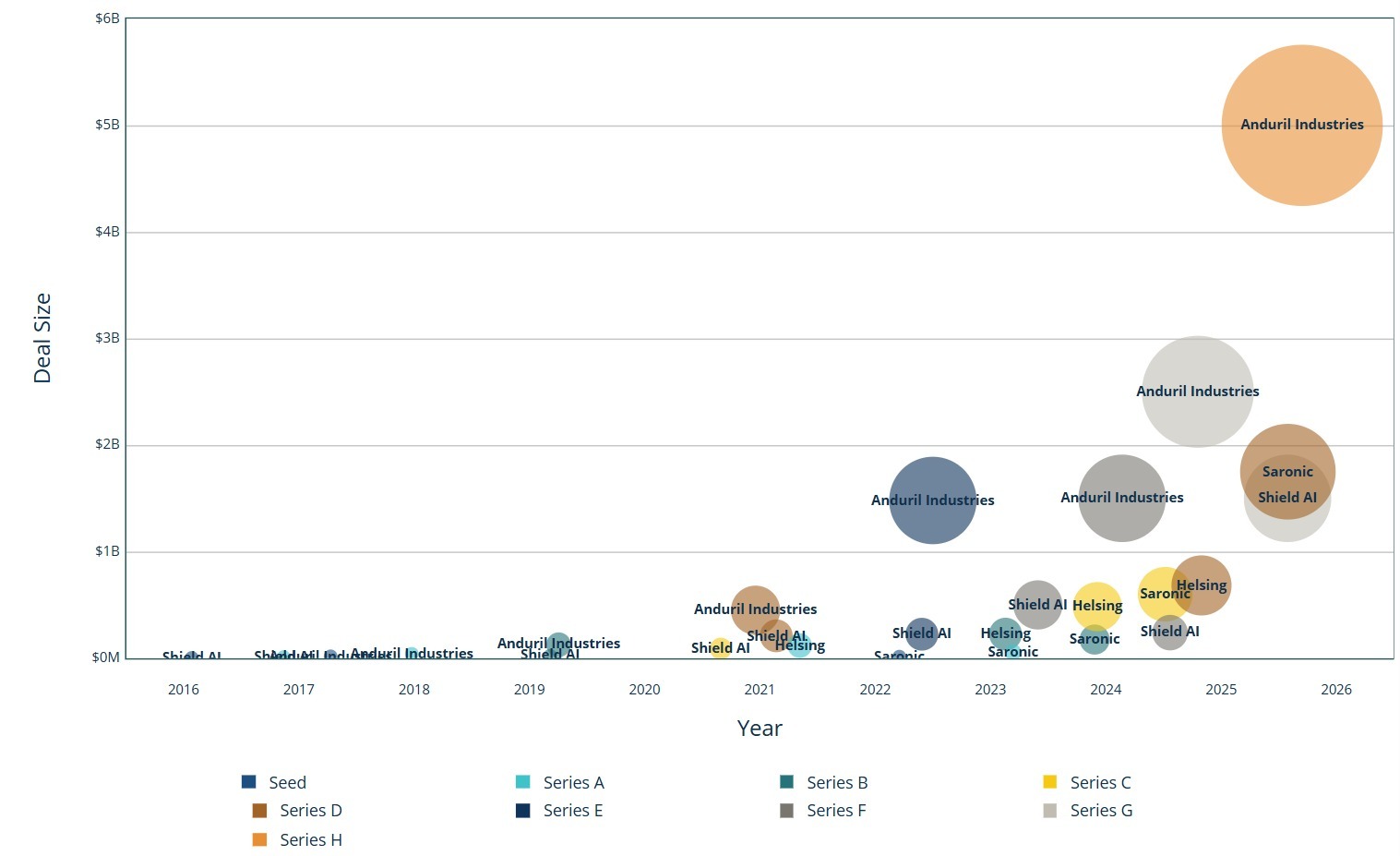
  • Startups are being founded with a focus exclusively on the defense domain, such as Helsing, Saronic, Shield AI, Anduril. They are clear examples of something that was not common in the past, certainly not at these scales.

IAI ELTA (Prime)

Capital, budgets, and system-level validation.

Defense startup funding bubble chart updated

Source: Based on Anthropic public disclosures, including the Series G funding announcement (Feb 2026) and subsequent executive statements and conference remarks (Apr–May 2026). Run-rate figures are annualized and not GAAP revenue.

Anduril last raised at a $30.5B valuation (Jun 2025). Reported plans point to a potential new round targeting ~$60B (not yet closed).

  • Capital Driven players are entering the defense domain "aggressively", including dual-use solutions, in numbers that simply did not exist before.
  • New Business Models are emerging within the sector - Ondas is one example.

All of this is not happening in a vacuum. Global defense budgets are accelerating at a pace not seen for decades. In the U.S, national defense requests have now entered the trillion‑dollar range for a single fiscal year; Within NATO, Allies committed at the 2025 Hague Summit to invest 5% of GDP annually on core defense requirements as well as defense ‑ and security‑related spending by 2035; and in Asia, India’s defense budget (excluding pensions) roughly $60B per year In the last five years, while Japan has launched a historic $320B five year buildup.

This shift is not just financial, it is changing how solutions are built and adopted. So, with all this money flowing, why should a startup work with us, and what do we offer? In short: not a logo on an investor deck, but deep validation: technological, business, and system-level.

The advantage of working with us lies in validation against real needs, emerging directly from our customers, shaped through close work on diverse defense solutions. Much of this stems from decades of intensive defense-related work by our people.

IAI ELTA (Prime)

From POC to Production - Converting Proof Into Adoption

This comes together with infrastructure and the ability to integrate into combat-proven legacy systems backed by years of R&D and real-world deployment. If we succeed together, it also provides access through us to long-standing relationships with our customers across dozens of countries worldwide, as well as to a reputation built over many years.

All of this enables the delivery of system-of-systems solutions aligned with real market needs, combining startup innovation and speed with deep, accumulated experience to create a genuine 1+1=3 outcome. If a POC meets its KPIs and the commercial alignment is right, it creates a clear path to adoption from a scoped validation, through integration and qualification, to procurement-ready deployment unlocking faster go-to-market and stronger scaling potential than an independent route.

We acknowledge the deep gap built into the process: we do not work like a startup, and the terminology, approaches, and time rhythms are different.

Precisely because of this, we are continuously improving our fast-track lanes (even now) to reduce response times across procurement, finance, legal, business development and software. We also offer preferential terms and flexibility - there is no one-size-fits-all rubric. Each engagement is tailor-made, aligned with the startup, and supported by a clear post-POC roadmap.

In defense, validation is what separates interest from adoption.

For startups building long-term solutions in complex markets, this kind of partnership requires strategic patience. When applied correctly, it can become a significant competitive advantage - not "just" patriotism.

JCT & Schreiber LevTech (Education)

Expanding Israel's Defense-Ready Engineering Pipeline

JCT Machon Lev logo

JCT & Schreiber LevTech
Expanding Israel's defense-ready engineering pipeline.

The Opportunity

Israel's defense-tech sector, and the country's need for advanced technology for its own security, is surging.

Demand for skilled engineers with product-building experience is critical.

Yet one of the most capable, motivated, and untapped talent pools in Israel remains on the sidelines of this boom: the Haredi and Orthodox engineering community, men and women, from Israel and around the world. Highly educated, technically rigorous, values-driven, and deeply committed to contributing to Israeli society—they are ready.

The constraint is often not the number of startups or programs. It is the pipeline of engineers who arrive ready with hands-on systems experience, exposure to real defense challenges, and the mindset to operate under real constraints.

JCT and Schreiber LevTech exist to build that pipeline and to open it to student populations that defense companies have not traditionally drawn from. That is where the opportunity is.

4,500

Students at JCT

~50%

Engineering students

39

Countries represented

38

Active startups supported

JCT & Schreiber LevTech

Who We Are

The Jerusalem College of Technology (JCT) is Israel's leading engineering institution for the religious and Orthodox community with 4,500 students across software engineering, electronics, electro-optics, industrial engineering, and computer science. JCT trains approximately 12% of all women studying computer science in Israel. Students come from 38 countries; over 90% remain in Israel after graduation. JCT alumni have contributed at leadership levels to some of Israel's most critical defense systems and have received an outsized number of Israel Defense Prizes.

Iron Dome & Arrow

Alumni on core development teams

Namer APC

JCT Colonel: chief engineer; 2024 Defense Prize

Tunnel Detection

World-first capability; multiple Israel Defense Prizes


The Schreiber LevTech Entrepreneurship Center is JCT's applied innovation engine giving students hands-on experience building real systems while they are still studying. It has run hackathons with industry and technology partners, supported 38 active startups, and runs accelerator programs connecting students to industry challenges and commercialization pathways.

The Talent Pool Defense Companies Are Missing

JCT draws from student communities that are highly capable, deeply committed to Israel's security and largely absent from defense company hiring pipelines. Not because of ability, but because the doors have not been opened.

Modern Orthodox engineers

These students have served in the IDF and most are active reservists combat, technical and engineering roles; others are in pre-army programs at JCT. They understand how defense systems are used, bring military discipline and operational thinking, and are actively building deeper technical expertise.

Haredi engineers

Academically rigorous, highly motivated, and deeply committed to contributing to Israeli society. JCT hosts three Haredi military programs where students serve in engineering-related fields. They will be engineers who are disciplined problem-solvers, strong in mathematics and computer science, and hungry to prove themselves in the field.

JCT & Schreiber LevTech

Talent Pool, Proof Points, and DefenseTech Center

Women engineers

Committed to Israel's security and many already work on proofs of concept for defense challenges at JCT. They are technically sharp and combine strong academic training with genuine motivation to contribute to the defense ecosystem.

International engineers from 38 countries

Immigrants from 38 countries outside of Israel chose to build their lives and careers in Israel. They bring fresh technical perspectives shaped by different educational systems and problem-solving cultures, with strong motivation to contribute. Over 90% stay in Israel after graduation.

These engineers get to working proofs of concept fast. The hackathons and startup portfolio demonstrate it. The DefenseTech Center can build the on-ramps that connect this talent to the companies that need them.

What We've Proven

Working Demo Hackathons: Speed to Working Systems

18 hackathons with industry and technology partners. The measure is not participation. It is that these students get to working demos and proofs of concept quickly. Under real constraints, with real challenge briefs, they deliver.

Cyber Elite: Pipeline Proof

A pilot intensive training program placing outstanding Orthodox and Haredi engineering graduates into cyber and defense-related R&D roles. Graduates hit the ground running in both commercial cyber and defense industry positions. It proved the model works.

Accelerator Programs

Students advance from early idea through proof-of-concept and prototype stages with structured support and industry input. This builds the systems mindset defense companies need in engineers from day one.

Defense System Contributions

JCT alumni at leadership levels across Iron Dome, Arrow 2 and 3, David's Sling, Namer APC, and tunnel detection technologies. Multiple Israel Defense Prize recipients. This is the track record of a community with more to give.

JCT & Schreiber LevTech

What We're Building: The DefenseTech Center

Building on a decade of running intensive extracurricular training rograms, deep engineering degree programs, and a demonstrated ability to get students to proofs of concept fast, JCT and Schreiber LevTech are establishing a DefenseTech Center.

Its purpose: move defense innovation upstream by developing talent earlier, integrating it more broadly, and anchoring Jerusalem as a complementary defense-tech hub alongside Tel Aviv, Be'er Sheva, and Haifa.

Talent acceleration

Industry-aligned training tracks embedded in degree programs. Defense-relevant exposure begins earlier so graduates arrive ready to contribute, not learning on the job.

Technology and proof-of-concept development

Structured pathways advancing student projects toward real defense applications with industry input and milestones. Not academic demos. Systems that work.

For defense companies, from startups to multinationals, this is a pipeline that is ready to open. The students are here. The track record is real.

JCT and Schreiber LevTech expand Israel's capacity to build, integrate, and deliver defense technologies by developing talent earlier, broadening who participates, and strengthening new centers of gravity.

Contact

Orlee Guttman | orlee@jct.ac.il | 054-594-6811

A Message From Abroad | Ariel Remer (Angel Investor)

North American Angel Investor supporting pre seed startups that make Israel safer.

Ariel Remer headshot

Ariel Remer

North American Angel Investor supporting pre seed startups that make Israel safer.

Israeli founders have always been exceptional builders, especially in defense and dual-use technologies. That part hasn’t changed. What has changed is the moment we’re in. There’s a growing recognition globally that the next wave of defense innovation will come from startups, teams that can move quickly, think differently, and build with a level of urgency that traditional systems often can’t match. For Israeli founders, that creates a very real opportunity to build companies that matter far beyond the local market.

At the same time, breaking into North America brings a different set of challenges. It’s not just about the quality of the technology, which is often world-class, but about how that technology is communicated, positioned, and understood in a new market. A lot of the work I’ve found myself doing with founders is around that layer. Sometimes it’s helping refine a deck so the story is clearer. Sometimes it’s making an introduction at the right moment. Sometimes it’s just pressure-testing how an idea is being framed for a North American audience. None of it is particularly glamorous, but it’s often where things start to click.

What makes The Sandbox valuable is that it brings structure to that process. It gives founders a place to sharpen what they’re building, clarify how they’re thinking, discover where it fits, and how markets will receive it. It creates an environment where small adjustments in messaging, in timing, in positioning can have a meaningful impact. In this current environment, those details matter.

There’s real momentum building in defense and dual-use technology. The capital is paying attention. Governments are more open than they’ve been in the past. The opportunity is there. The founders who can translate what they’ve built into something the market can immediately understand are the ones who will move the fastest. It’s been exciting to spend time alongside teams as they work through that process, and I’m looking forward to seeing more of them break through in the months ahead.

Industry Voice | Greenspoon Marder Israeli Practice

Greenspoon Marder logo

Greenspoon Marder Israeli Practice Collaboration with LDS: Your U.S. “One-Stop Shop” is Here.

Every early-stage founder knows this exact dilemma.

You know your target market is in the U.S., and you want to understand the regulations that apply to your product.

You might wonder where to incorporate in the U.S., how to secure your IP, or if you are even ready to start fundraising and selling there.

Yet, you are unsure where to start, what steps to take, how to protect yourself, and how to avoid crushing legal fees.

This is exactly where we come in.

Driven by a deep commitment to support Israel’s resilient tech ecosystem — and sharing the same “let’s do something” mindset — Greenspoon Marder is thrilled to announce the collaboration of our dedicated Israeli Practice with Let’s Do Something.

Our mission is simple: to remove friction and empower Israeli companies to seamlessly expand, operate, and succeed across the U.S.

Who We Are

Greenspoon Marder is a premier, full-service U.S. law firm with 20 offices across the United States and a powerhouse team of 230 attorneys.

Our Israeli Practice features both U.S. and Israeli attorneys who deeply understand the business culture on both sides of the ocean and have a proven track record of serving clients in cross-border matters.

While we boast a deeply experienced and robust Technology department, we are built to be a true One-Stop Shop. We provide every single legal discipline a growing startup needs when entering the U.S. market — including Regulatory Compliance, Corporate, Employment Law, Tax, Intellectual Property (IP), and more.

Greenspoon Marder Israeli Practice

How We Are Going to Help You.

We are not just here to provide legal counsel; we are here to actively build bridges.

In collaboration with LDS, we are launching several initiatives designed specifically for early-stage founders who are looking to scale in the U.S.

Masterclasses & short complimentary lectures

Deep dives into critical, early-stage topics — such as where and when to incorporate in the U.S., securing your IP, and practical tips for successful fundraising.

Dedicated office hours

Direct, one-on-one access to our attorneys to answer your specific legal and business questions, at no cost.

The GM “Tech Package”

A customized legal package tailored for Israeli startups, offering flexible and founder-friendly fee structures to accommodate your runway.

Strategic connections

Leveraging our massive U.S. network to proactively connect you with potential investors, strategic partners, and clients.

A U.S. legal bridge for Israeli startups

For founders entering the U.S., the challenge is rarely just one question. Incorporation, IP, fundraising readiness, employment, tax, regulatory exposure, and commercial expansion all touch each other.

Our Israeli Practice is designed to help founders navigate that complexity with attorneys who understand both the Israeli and American business environments.

This is just the beginning. Stay tuned.

We are already working closely with the LDS team on a number of exciting projects to bring these resources to life.

Want to get a head start or have an immediate question? Reach out to us today at info@gmlaw.com.

Contact Greenspoon Marder

Industry Voice | Fresh Defense (Seed Investor)

Why the Next Wave of Defense Innovation Starts at Pre-Seed

Commentary from Fresh Defense — Pre-Seed Fund, 16 defense investments since 2020

Fresh Defense logo

Fresh Defense

Pre-Seed Fund, 16 defense investments since 2020

The nature of defense innovation is shifting at an unprecedented pace. For decades, technological breakthroughs emerged from government labs and prime contractors through development cycles spanning years. Today, the epicenter of disruptive capability has shifted toward startups, specifically those at the pre-seed stage. This is where ideas are boldest, teams are agile, and core architectures are forged before legacy constraints take hold.

As a pre-seed fund that has led 16 defense investments since 2020, 12 of them in the past year through Fresh Defense, we’ve seen this play out in real-time within the Israeli defense tech ecosystem, one that punches far above its size and serves as a bellwether for global innovation trends.

Throughout this year we’ve met with over 150 defense companies (and founders), working in different defense sub-domains trying to build the protection of the future. The founders we met were determined, mission driven and fueled with a deep sense of purpose. They are planning to take their battlefield experience and bring it into the industry in the aim of solving the most pressing problems armies and entities currently suffer from.

16

Defense investments since 2020

12

In the past year through Fresh Defense

150+

Defense companies and founders met this year

The Global and Israeli Defense Innovation Landscape

Defense venture funding has grown significantly worldwide and reached an historic “Supercycle” in 2025 as investors and governments seek tomorrow’s technologies today.

Global startup funding in aerospace and defense crossed $19 billion in 2025, nearly doubling prior years as technologies like AI, autonomy, and secure communications attracted capital.

Fresh Defense

Why Pre-Seed and Why Now

This trend is mirrored in Israel, where the ecosystem demonstrated remarkable resilience; in 2025, Israeli startups raised over $15.6 billion, with defense-tech attracting over $1 billion in activity, a record that underscores Israel's role as a global anchor for critical security technologies.

What makes Israel remarkable is not just total capital, but stage distribution: a high proportion of early-stage ventures intensely focused on next-generation capabilities like spectrum sensing, AI-enabled defense systems, and secure communications, the very domains reshaping modern battlefields.

This "market pull" is fueled by geopolitical realities, with global military expenditure reaching $2.7 trillion. Modern militaries are actively seeking alternatives to legacy prime contractors, with a significant portion of new AI and autonomy contracts now flowing to tech-first startups rather than traditional primes.

This is the fertile ground in which pre-seed defense startups thrive, and why investors who enter before traction often get the greatest strategic and financial leverage.

For true innovation to occur, founders must build their core architecture from scratch, they need to shape their product requirements directly with the customers tailoring it to their specific needד and be in constant communication with the market.

In dynamic domains like spectrum sensing, secure communications, and fusion analytics, pre-seed innovation sets the trajectory for entire categories. Startups like R2 Wireless (who were our first investment in defense back in 2020) demonstrate the power of this timing; by securing early backing, they gained the runway to develop differentiated IP that positions them as strategic partners to larger entities. Investors who enter at this stage gain significant leverage, as these companies often grow into massive late-stage rounds evidenced by the $2.5B and $600M "mega-rounds" seen in 2025 or become prime acquisition targets for industry leaders looking to buy proven, cutting-edge technology.

Fresh Defense

How to win today’s defense market

However, the path forward for defense startups in the next two to three years involves navigating specific, high-stakes hurdles. The first is capital intensity; unlike software-only SaaS, defense ventures, particularly those with hardware components, require significant R&D and compliance investment before reaching scale. Reaching a Series A often requires substantial follow-on funding, making pre-seed validation a critical gatekeeper. Furthermore, the "Valley of Death" , the gap between a successful pilot and a full government contract remains a daunting obstacle. Startups must navigate lengthy acquisition cycles and rigorous certification requirements while proving reliability to risk-averse procurement officers. Additionally, as the sector matures toward 2028, we expect accelerating consolidation, where the ability to scale manufacturing and secure specialized talent in fields like tactical AI will separate the market leaders from the rest.

Despite these challenges, the case for pre-seed defense investment has never been stronger. The current environment offers a unique window where early-stage ventures can outpace legacy cycles and define the future of national security. As we look toward 2026, we see it as a pivotal year for the sector to demonstrate its resilience and disruptive power. By providing founders with the runway they need to build and grow and the network to reach global stakeholders, pre-seed funding acts as the ultimate catalyst. The race for a technological edge is already underway, and for those seeking to lead the next wave of defense innovation, the starting line is at pre-seed.

To founders building in defense today, here are a few things that might help you navigate through this market; first of all understanding that the real optimization is not product-market fit, but trust-market fit. The data shows that the companies that scale, survive procurement cycles, and ultimately drive premium outcomes are those that behave early like long-term defense counterparties rather than scrappy startups: they design their organizations, documentation, compliance posture, and decision-making for scrutiny and stress; they are intentional about who their first reference customer is and over-invest in credibility over short-term growth; they protect their information asymmetry with primes until real leverage exists; and they build systems that work not just in demos or peacetime, but under degraded, wartime conditions. In a market moving rapidly toward consolidation, where acquisition decisions are driven more by strategic trust and survivability than by revenue multiples, founders who internalize this early create disproportionate advantage because in defense, reputation compounds faster than growth, and organizational trust is the scarcest asset of all.

We are confident that, together, the exceptional Israeli founders building defense technologies today and the seed to growth investors who recognize the strategic importance of this sector will play a central role in bringing Israel’s frontier defense innovation to global markets. By leveraging Israel’s most advanced and battle-tested technologies, this ecosystem is uniquely positioned to support allied nations in addressing current and emerging global security challenges, a process that, as we are already witnessing, begins at the earliest stages and compounds over time.

Industry Voice | Protego Ventures (Growth Investor)

Turning Israeli Battlefield Credibility into Global Delivery

Commentary from Protego Ventures — Early-Growth Defense Tech Investor

Protego Ventures logo

Protego Ventures

Early-Growth Defense Tech Investor

The second half of 2025 brought a long-awaited sense of relief. The defense sector’s frame shifted from survival to sustainability, raising a new question: could Israel’s defense innovation engine sustain and scale its momentum once the wartime pressure eased?

One answer came in September, when the Tel Aviv Stock Exchange launched dedicated defense indices representing 20 companies with a combined market capitalization of roughly ₪110 billion. The message was not only that defense had outperformed, but that public markets were beginning to treat the category as investable and durable, rather than a wartime anomaly.

In November, the private market delivered its own signal. Three Israeli homeland security and defense technology companies were acquired in quick succession: Carbyne, which was co-founded by our Managing Partner, Lital Leshem, was acquired by Axon in a $625 million cash deal; Orbit Communication Systems, a military SATCOM leader, agreed to be acquired by Kratos for $356.3 million; and Sentrycs, a counter-UAS company, was acquired by Ondas in a $225 million transaction.

₪110B

Combined market capitalization of 20 companies in dedicated TASE defense indices

$625M

Carbyne acquired by Axon

$356.3M

Orbit Communication Systems agreed to be acquired by Kratos

Protego Ventures

Readiness stack and U.S. delivery

Taken together, these are markers of an ecosystem maturing, slowly but visibly. When exits begin clustering, public indices form, procurement expands, and defense innovation moves from episodic urgency to institutional permanence. On the policy side, Israel’s 2026 budget is isncreasing defense spending to around ₪112 billion, reinforcing that the demand environment and procurement pipeline are set up to remain structurally higher than pre-war baselines. Critically, the Ministry of Defense is not only buying more, but also signaling a stronger intent to channel R&D into startups and SMEs through MAFAT (DDR&D), tightening the loop between operational need and venture-scale delivery.

What changes next is the bar for what “ready” actually means. Combat validation still matters, but the companies that win globally are the ones that pair performance with real-world readiness.

At Protego Ventures, we evaluated more than 30 companies in the past six months, across sectors and platforms, and several consistent patterns emerged. 1. TRL, on its own, proved to be a weak proxy for maturity. 2. Intellectual property extended far beyond patents into deployment know-how and hard-earned operational lessons. 3. Regulatory and compliance constraints shaped system architecture earlier than many teams anticipated. 4. Integration into legacy environments surfaced as the most common breakpoint, not because the technology failed, but because the surrounding infrastructure had not been designed for institutional adoption. 5. Teams with deep, hands-on defense experience consistently outperformed larger teams without it, and 6. business models built around standalone product sales struggled against long procurement cycles and platform-centric buyers.

That readiness stack matters most in the U.S., because it is the largest defense market and the most demanding environment for repeatable delivery. The U.S. does not reward novelty on its own. It rewards solutions that can be integrated into existing architectures, transitioned through real procurement pathways, and sustained without breaking operational baselines. The timing is particularly compelling because U.S. acquisition is widening its aperture for nontraditional suppliers and faster pathways to fielding. The Army’s FUZE construct alone has already aligned roughly $750 million to this model, reflecting a broader shift toward accelerated transition and deployment for technologies that can be delivered with discipline.

Protego Ventures

From battlefield credibility to institutional delivery.

Washington is now reinforcing that shift from the top down. Secretary of Defense Pete Hegseth has launched what the department describes as a warfighting acquisition overhaul, intended to flatten acquisition hierarchies and push more decision authority into mission-aligned portfolios. The stated goal is to move faster from requirement to contract to fielding, with clearer incentives for production and sustainment outcomes. In parallel, President Trump publicly called for a step-change in U.S. defense spending, proposing a $1.5 trillion military budget for 2027, up from $901 billion in 2026, signaling multi-year demand and procurement runway for companies positioned to scale.

So what does this mean for Israeli founders and the broader defense technology ecosystem? It means the U.S. is opening a larger, faster-moving window for companies that can translate Israeli battlefield credibility into institutional delivery. The opportunity is not only to sell into the U.S., but to become embedded suppliers inside enduring defense programs by building the manufacturing discipline, integration posture, compliance architecture, and U.S. presence that create trust.

This is where Protego Ventures comes in. We invest in early growth defense tech: companies that have already demonstrated real demand from serious customers and moved beyond experimentation, and are now at the stage where the question shifts from “does it work?” to “can it be delivered repeatedly, under real constraints, with the operational maturity that primes and program offices require?” Early growth is where interoperability becomes a product discipline, manufacturing becomes a strategic capability, and the U.S. market becomes accessible only once a company has built the foundations of presence, program fluency, and a delivery system that holds.

XTEND, our first portfolio company, demonstrates what operational maturity looks like in practice. Its progress in the U.S. was not the result of a single moment. It was built through deliberate investment in American presence, manufacturing readiness in Tampa, and the compliance and delivery infrastructure required to execute inside U.S. defense ecosystems. When primes choose to integrate startup capability into their own platforms, it signals a durable shift in the market: speed and interoperability are now strategic advantages, and startups that can deliver both are becoming embedded contributors to how the U.S. fields next-generation systems.

Israel has already proven it can produce battle-tested capability under pressure. The next leap in 2026 is turning that advantage into a durable global stronghold by building companies that are institution-ready by design, and U.S.-ready in practice.

The winners will be founders who treat delivery as a core product, build for integration from day one, and invest early in the operational maturity that makes scale repeatable.

Startup Spotlight | Intact

Eliminating Friendly Fire on the Modern Battlefield

By Meir Rapaport, CEO, Intact

Intact logo

Intact
A soldier's personal safety system.

While running a B2B startup and meeting our first customers, two close friends of mine were killed by friendly fire, learning that ~25% of casualties during war are caused by friendly fire incidents. I understood that I need to create a winning team to build, create and develop a technology to prevent the next unnecessary death. That commitment became my entry point into the defense world.

The defense industry is not easy. It is tough, complex, and dominated by giants with decades of experience, deep budgets, and long-standing relationships. The processes are slow, bureaucratic, and often frustrating. Validation takes time. Trust takes even longer. You cannot rush credibility in this field — it must be earned through persistence, performance, and resilience.

B2G vs. B2B vs. B2C: A Reality Check

DimensionB2G (Defense)B2BB2C
Contract SizeMillions of dollarsThousands to millionsIndividual dollars
Buyer ComplexityVery difficult — the one experiencing the pain is not the one controlling the budgetStructured — companies have defined budgets and needsEmotional — requires strong marketing and personal targeting
CompetitionSmall number of competitors, but dominated by giantsMedium competition in large marketsLarge competition, but market size supports many players
Process LengthVery long — 2–5 years to close a dealMedium — weeks to monthsShort — hours to days

To succeed in the defense industry, technology alone is not enough. You need patience, long-term commitment, thick skin, and real resilience. Progress is slow, setbacks are frequent, and credibility must be earned over years, not months. More than anything, you need purpose and love. Love for your country, love for the people who serve and protect it, and love for the problem you are committed to solving. This industry will test you professionally, emotionally, and strategically. If your motivation is only financial, the pressure, the bureaucracy, and the obstacles will eventually wear you down. But if you are driven by something deeper than profit — by responsibility, mission, and impact — then you have a chance to succeed.

For me this industry is not just business, it is a chance to save lives. It is purpose.

Startup Spotlight | Intact

The Problem Intact Solves

Founded in 2022, Intact was established with a single, urgent mission: to eliminate friendly fire on the modern battlefield.

Today's combat environment is faster, more complex, and more electronically contested than at any point in history. Drones, warfighters, armored vehicles, and autonomous systems operate simultaneously in dense, multi-domain battlespaces — often under persistent Russian, Iranian, and Chinese electronic warfare pressure.

Historically, up to 25% of battlefield casualties in certain conflicts have been attributed to friendly fire, underscoring the urgent need for a survivable identification solution that works even when communications are denied and forces cannot visually confirm one another.

The Technology

After two years of focused breakthrough development, Intact's team engineered a millimeter-wave, non-jammable IFF architecture designed for high-intensity and EW-contested combat. Operating in a highly directional, low probability of intercept and low probability of detection spectrum, it remains functional where traditional RF systems are jammed, intercepted, or used as beacons to locate forces.

Intact's technology delivers real-time positive identification between warfighters, drones, and vehicles without exposing positions or creating exploitable signatures. It enables recognition through obstacles, obscurants, and complex terrain — reducing fratricide risk while increasing operational tempo, survivability, and confidence in maneuver.

Intact is not just an IFF solution. It is a survivable, covert identification and awareness infrastructure built for the present and future battlefield where saving lives, maintaining combat effectiveness, and operating under constant EW threat are inseparable.

Conclusion

From Improvisation to Industry: The Mandate Is Simple

Israel has proven it can innovate under pressure. The next chapter is industrialization. The question is no longer whether Israel can build under fire. The question is whether it can institutionalize and globalize what it built.

Can battlefield credibility become repeatable companies?

Can prototypes become programs?

Can pilots survive the Valley of Death and turn into sustained contracts?

Can Israeli startups embed inside allied defense architectures — not as vendors of the moment, but as permanent suppliers?

Execution discipline will determine the answer. In a noisy ecosystem, founders who ship and investors who dive in are the signal. The ones who iterate through failure, absorb procurement friction, rebuild under constraint, and show up again are the real infrastructure of this industry. If Israel succeeds, it will not be because it convened the most panels or produced the most strategy decks. It will be because it delivered systems properly, integrated into legacy environments, and scaled without breaking.

Conclusion

The Full Stack Ecosystem Model

A durable ecosystem requires alignment across:

1

Pre-seed architecture formation

2

Early execution validation

3

Growth-stage industrial scaling

4

U.S. and allied institutional embedment

Israel possesses components of each layer. The friction lies in transitions between them. Ecosystem durability will depend on improving stage-to-stage throughput.

Strategic Implications for Stakeholders

Defense-tech is no longer solely venture territory. It is strategic infrastructure. Mission-aligned capital plays a decisive role in bridging structural gaps that pure venture economics may underfund. Capital can:

  • Fund demo-stage validation
  • Support pilot-to-contract transition
  • Strengthen procurement fluency
  • Enable early U.S. readiness
  • Improve ecosystem coordination

The next three years are decisive. Either this surge becomes a permanent pillar of Israel’s industrial base, or it becomes a moment remembered for its intensity but not its durability.

Build, integrate, deliver.

Best of luck everyone.

Powered by Let’s Do Something

Defense Insight Report

Israel Defense-Tech 2026 Q1-Q2

From Battlefield Urgency to Industrial Scale